
and slowing things down
- Morning pages: change I noticed within a short time:
- Calm
- Benefits of analogue journaling
- Digital overload
- There is one more
- Bonus Content and Side-quest sentences

In spring one of my wonderful colleagues Mary McQuade lent me her copy of The Artist’s Way by Julia Cameron1 and while I worked my way through the twelve week self-coaching, I began writing Morning Pages.
Morning pages are a fairly straight forward2 writing technique:
First thing in the morning, usually with a cup of coffee, spend half an hour or so and write three pages (A4–or thereabouts) by hand. If you are able to write by hand the physical act of handwriting is important here. You write about anything that pops into your mind. If you struggle to begin writing the author suggests to begin with describing what you are able to pick up on. For me it is usually the weather3, birdsong I can identify, if I heard the owls during the night, or the foxes bickering. That usually is enough to make my mind wander–and sometimes wonder–into writing.
Morning pages: change I noticed within a short time:
Writing morning pages I noticed ideas and memories bubbling to the surface, which needed attention. Sometimes it were things I had forgotten, connections the brain made between different experiences, and sometimes simply stuff that needed to move out of the system and onto the page–so I wouldn’t have to hold on to it any longer. The morning pages became a storage space for mind clutter, record of ideas and insights, and sometimes a place for poetry and other creative writing.
Writing encouraged me to read, which in turn encouraged me to write more, which in turn encouraged me to read more … you get the point.
And then …
After some time, there was this strange new thing. A heretofore unknown entity that settled in an uneasy truce … calm.
Calm
Now the only experience akin to calm I had so far, was the absence of anxiety attacks, or the presence of distraction, but actual calm! That is new.
Needless to say: I had to know. What does research say about this? The relationship between handwritten journaling and calm.
Down the rabbit hole I went!
Next is a brief overview of the benefits of analogue (handwritten) journaling. The funky footnote feature leads you to the resources. But there were so many more. So many!
Benefits of analogue journaling
- it helps with managing anxiety and other mental health issues
- aides prioritization
- reduces stress
- improves memory
- enhances creativity4
- develops self-awareness5
- and the most surprising find it appears to have a positive effect on the immune system6
But this is not all!
I stumbled across exploratory research about the journaling ecosystem of material, personal context and community!7 I am so in love with this project. The authors for instance identified that materiality was not only about the ability for journal writers to express themselves, but about the physicality of the experience–here even the smoothness of paper is mentioned. This very much links to my recent explorations around embodied learning. But this is a whole other blog post or two.
Here are some of the interesting things the authors found:
- size (of the journal) shapes thought
- e.g. a smaller format makes beginning to journal less daunting
- journaling creates a space (time) for reflection
- aesthetic brings joy8
- it impacts on the development of identity
- this is also linked to reminiscing, which in turn has a positive impact on resilience development and mental health9
- and shapes the journaler’s mindset
And finally I would like to conclude the snapshot from down the research rabbit hole with a paper from HCI (Human Computer Interaction) researchers who wanted to understand analogue journaling for better product development.10 It has some very interesting references to follow up on. They also identified journaling as identity work and speak of (bullet) journaling as a deliberate act of self-creation8.
In conclusion so far it seems as if most research indicates that there is indeed a connection between handwritten journaling and improved mental health. And there is one more aspect to this story:
Digital overload
I think the results of my evening spent in the rabbit hole of trying to figure out if or rather how this bizarre new state of calmness was created by engaging in morning pages. Left me with more questions than answers (and there will be more posts) but it is fairly safe to conclude that journaling–particularly analogue journaling–can reduce stress, supports positive identity negotiation (even forming?11) and brings joy.
There is one more aspect, that requires more inquiry, I have noticed that with the emergence of this new state of calm, came a significant reduction in screen time. This led to two search terms: information overload, and digital overload, the latter has now made it into research papers as a topic of exploration.
I think that this quieting of the mind I experienced with regular journaling, is also strongly related to consuming less information. Julia Cameron writes about resting on the page using journaling (e.i. morning pages) as time out. And this effect has been so profound that I have moved my work activity as much as possible off-line. The ADHD brain has a bit of an issue with object representation the number of times I created double, or triple copies of files in my cloud drive because I had forgotten I already had one, and the logic I used at the time to create the filing system was not the logic that was later accessible to me, even the naming (which at the time was very obvious) and so I cannot find the file or I cannot remember that I ever worked on something.12
Queue moving things into physical journals. I used to have a highly effective journal ecosystem a BuJo (messy notes), a tidy notes journal, and a mind-map journal. And then came lockdown, and the move online, the inception of platforms such as notion and liquid text (which at the time were sanity savers), and my analogue system fell by the wayside. The increase of stress was not only caused by digitizing everything13 and constantly being online, but that by doing so I had forgone thinking time. Yes, I know I have tried to counter these effects with strategies such as Micro Art Breaks and Nordic Walking, but these alone were not enough to stem the pervasiveness of growing information and digital overload.
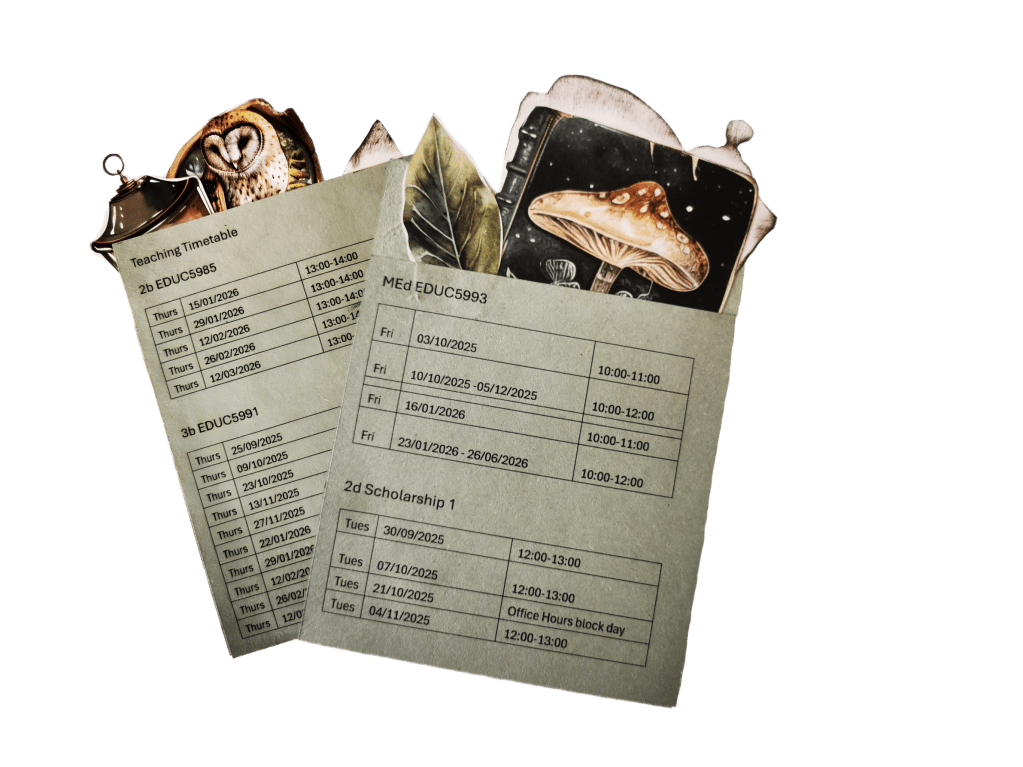
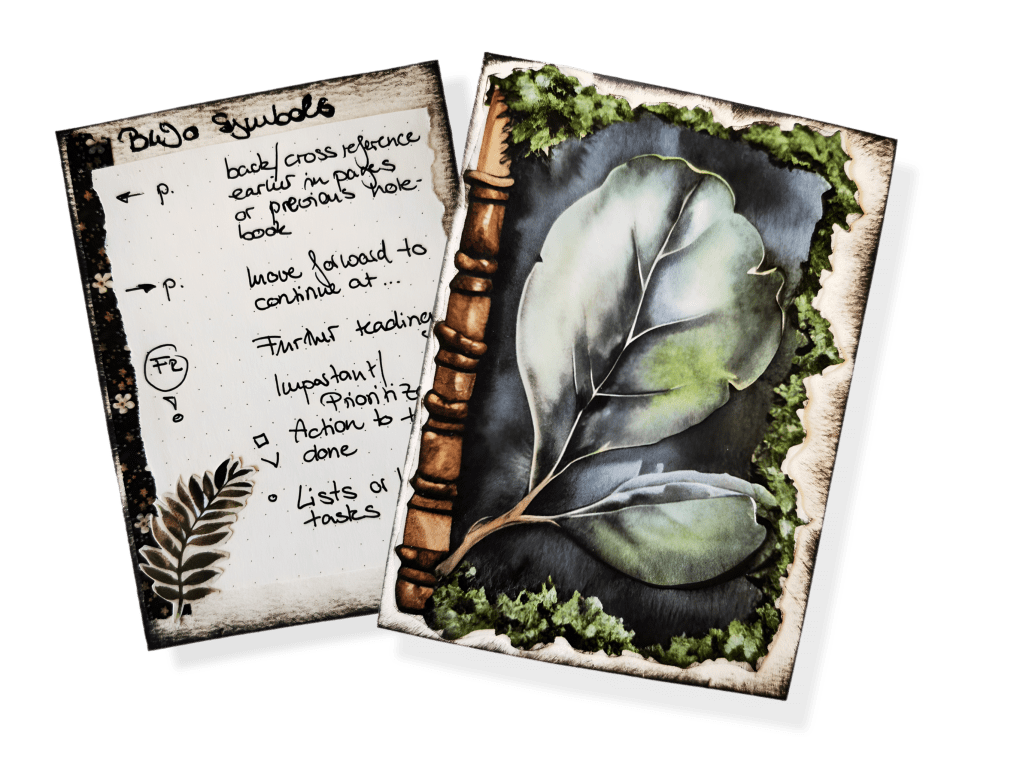
For this academic year, I am going back to undertaking as much work as possible offline, project planning, mind-mapping, teaching prep, year planning, preparation for admin tasks. With the significant improvement of handwriting-recognition and voice-typing this has now become possible and effective. Besides, remember the joy aspect from above? I have now made some cute artefacts for my BuJo which are cards with my teaching and CPD timetable for the year, assessment times, BuJo symbol glossary. And everytime I hold these they bring joy and I remember where the timetable is.
There is one more
but this is for another post.
In the meantime if you want to do some pre-reading this is the article:
Yinger, R. J., & Clark, C. M. (1981). Reflective Journal Writing: Theory and Practice. Institute for Research on Teaching, College of Education, Michigan State University, 252 Erickson Hall, East Lansing, MI 48824 ($3. https://eric.ed.gov/?id=ED208411
Bonus Content and Side-quest sentences
aka some of the papers and articles I read during my evening in the rabbit hole
- There are a couple more blogposts coming your way about this book. But if you do not know it, here is a Amazon UK abstract for the book:
“The Artist’s Way provides a twelve-week course that guides you through the process of recovering your creative self. It aims to dispel the ‘I’m not talented enough’ conditioning that holds many people back and helps you to unleash your own inner artist. Its step-by-step approach enables you to transform your life, overcome any artistic blocks you may suffer from, including limiting beliefs, fear, sabotage, jealousy and guilt, and replace them with self confidence and productivity. It helps demystify the creative process by making it a part of your daily life. Whatever your artistic leanings, this book will give you the tools you need to enable you to fulfil your dreams.” ↩︎ - until you try writing them every day ↩︎
- It’s a Scottish infliction what can I say? ↩︎
- always an easy way into a topic https://www.psychologytoday.com/us/blog/modern-minds/202301/10-good-reasons-to-keep-a-journal; https://www.urmc.rochester.edu/encyclopedia/content?ContentTypeID=1&ContentID=4552 ↩︎
- Rafizadeh, Elbina , Stephen Morewitz, and Arnab Mukherjea. 2021. “Handwritten Journals for Supporting Behavior Change among University Students.” The International Journal of Health, Wellness, and Society 11 (1): 143-157. doi:10.18848/2156-8960/CGP/v11i01/143-157 ↩︎
- 10.1097/01.psy.0000116782.49850.d3 this one is dated and the positive link to immune system is likely related to stress reduction through journaling c.f.: Scott, E. (2011). The benefits of journaling for stress management. About. com Stress Management ed online. ↩︎
- https://doi.org/10.1145/3698061.3726923 ↩︎
- Yes!!! This is my lived experience also ↩︎
- e.i.: https://doi.org/10.1111/aphw.12364, & https://doi.org/10.3389/fpsyt.2023.1139700 ↩︎
- https://doi.org/10.1145/3313831.337641 ↩︎
- one of the questions bookmarked for further reading ↩︎
- queue almost forgetting to add keynote and invited talks to my annual review because well I forgot ↩︎
- One of my biggest elements of grief is that we do not teach in person anymore ↩︎
 Nathalie Tasler, PhD, SFHEA, MPhil, PGDip CCM, PGCert LTHE
One thought on “Let’s talk analogue journaling”